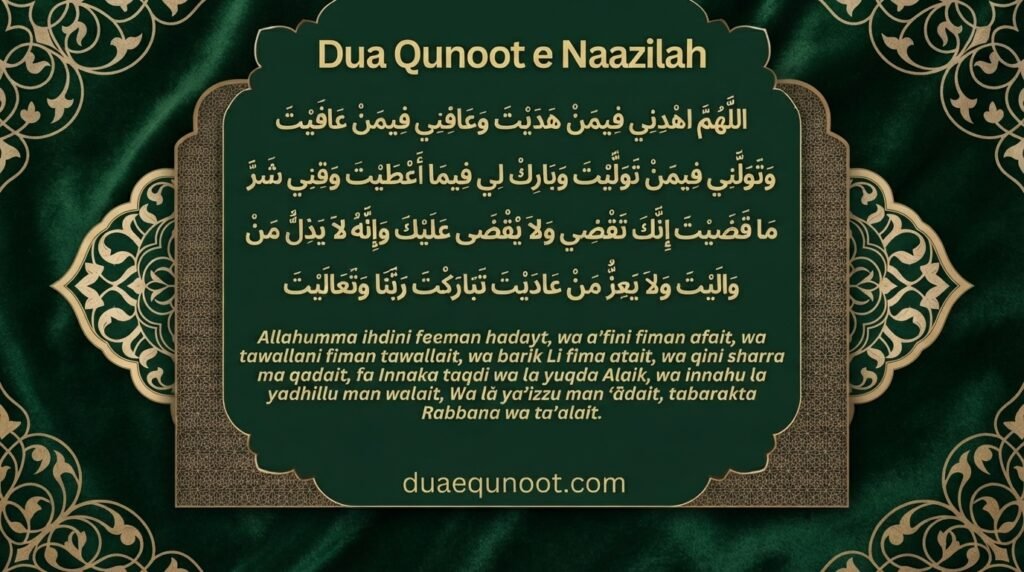
Dua e Qunoot is a special supplication recited standing during the Witr prayer, usually in the third rak’ah after Qur’an recitation (or after ruku, according to some schools). It asks Allah for guidance, protection, forgiveness, and blessing. There are more than one authentic version of this dua — the Hanafi school recites it in every Witr prayer, while other schools recite Qunoot mainly in Fajr prayer, or during Qunoot-e-Nazilah in times of hardship. This guide covers every version, in Arabic, Urdu tarjuma, and English translation, along with word-by-word meaning, correct method, and answers to the questions Pakistani Muslims ask most.
- Key Takeaways
- What Is Dua e Qunoot?
- Dua e Qunoot — All Versions (Arabic, Urdu Tarjuma, English)
- Dua e Qunoot Word by Word (Urdu and English)
- When Is Dua e Qunoot Recited? (Hanafi, Shafi’i, Maliki, Hanbali)
- Dua e Qunoot Before or After Ruku?
- How to Recite Dua e Qunoot in Witr (Step by Step)
- Qunoot-e-Nazilah: What It Is and How It’s Different
- Agar Dua e Qunoot Yaad Na Ho Toh Kya Parhein?
- Is Dua e Qunoot Compulsory (Wajib) in Witr?
- Benefits of Reciting Dua e Qunoot
- How to Memorize Dua e Qunoot Easily
- Common Mistakes When Reciting Dua e Qunoot
- Frequently Asked Questions
- References
- Explore Dua e Qunoot by School of Thought
Key Takeaways
- Dua e Qunoot is a supplication (dua) recited during Witr prayer, and in some traditions during Fajr.
- There are two commonly recited authentic versions in Pakistan — a shorter one and a longer one — and scholars confirm both are correct to recite.
- The Hanafi school recites it in every Witr prayer, standing after the third rak’ah’s Qur’an recitation, before ruku.
- The Shafi’i, Maliki, and Hanbali schools generally reserve Qunoot for Fajr prayer during calamity (Qunoot-e-Nazilah), with some flexibility around Ramadan Witr.
- If you haven’t memorized it, a short substitute dua is permissible until you learn it.
- This guide covers Arabic text, Urdu tarjuma, English translation, word-by-word meaning, correct method, and a downloadable PDF — everything in one place.
What Is Dua e Qunoot?
Dua e Qunoot is a supplication asking Allah for guidance (hidayah), protection (‘afiyah), forgiveness (maghfirah), and blessing (barakah) in one’s life and after death. The word “Qunoot” carries the meaning of devotion, humility, and standing obediently before Allah in prayer.
It is not a verse of the Qur’an. It is a dua taught by the Prophet Muhammad ﷺ — most famously to his grandson, Al-Hasan ibn Ali (RA) — and preserved through hadith literature. Because it is a supplication rather than a fixed Qur’anic recitation, more than one authentic wording exists, which is why you’ll find slightly different versions used across the Muslim world.
Dua e Qunoot in Arabic, Urdu Tarjuma and English Translation (Full Text — All Versions)
Many people search for “dua e qunoot 2” or ask “which dua e qunoot is correct” because two different versions are commonly taught in Pakistan. Both are authentic. Below are both, in full.
Version 1: Dua e Qunoot (Short) — Narrated from Al-Hasan ibn Ali (RA)
This is the version most commonly taught first, and the one most people mean when they search “dua e qunoot in english.”
Version 2: Dua e Qunoot (Longer) — “Allahumma Inna Nasta’inuka”
This is the version many Pakistani households know as “the” Dua e Qunoot, and it’s the one usually printed in Namaz booklets alongside Witr prayer instructions.
Hadith source (Version 1): Narrated by Al-Hasan ibn Ali (RA) — Sunan Abu Dawud 1425, Jami’ at-Tirmidhi 464, and Sunan an-Nasa’i 1746. Graded sahih/hasan by Al-Albani.
Source (Version 2): This wording is reported from Umar ibn al-Khattab (RA), originally used in the context of Qunoot al-Nazilah/Fajr rather than as a specific Witr hadith. It has been widely adopted in the Hanafi tradition — particularly in South Asia — and is commonly printed alongside Version 1 in Namaz booklets for recitation in Witr. Some Hanbali scholars (as noted by Ibn Muflih) held that combining both is also acceptable.
Note: Both versions are acceptable to recite. Some reciters also combine elements of both. If you follow the Ahle Hadees / Salafi method specifically, our dedicated Dua e Qunoot Ahle Hadees guide covers the exact wording and Sunnah method preferred in that tradition, along with its hadith references.
Dua e Qunoot Word by Word (Urdu and English Meaning)
Understanding each word helps you recite with meaning instead of by rote. Here is Version 1 broken down phrase by phrase:
| Arabic Phrase | Transliteration | Urdu Meaning | English Meaning |
|---|---|---|---|
| اللَّهُمَّ اهْدِنِي فِيمَنْ هَدَيْتَ | Allahumma ihdini fiman hadayt | اے اللہ، مجھے ہدایت دے ان میں جنہیں تو نے ہدایت دی | O Allah, guide me among those You have guided |
| وَعَافِنِي فِيمَنْ عَافَيْتَ | wa ‘afini fiman ‘afayt | اور مجھے عافیت دے ان میں جنہیں تو نے عافیت دی | and grant me well-being among those You have granted well-being |
| وَتَوَلَّنِي فِيمَنْ تَوَلَّيْتَ | wa tawallani fiman tawallayt | اور مجھے اپنی کفالت میں لے | and take me into Your care among those You have taken into Your care |
| وَبَارِكْ لِي فِيمَا أَعْطَيْتَ | wa barik li fima a’tayt | اور برکت دے مجھے اس میں جو تو نے عطا کیا | and bless for me what You have given |
| وَقِنِي شَرَّ مَا قَضَيْتَ | wa qini sharra ma qadayt | اور مجھے اس کے شر سے بچا جو تو نے مقدر کیا | and protect me from the evil of what You have decreed |
| فَإِنَّكَ تَقْضِي وَلَا يُقْضَى عَلَيْكَ | fa innaka taqdi wa la yuqda ‘alayk | بیشک تو ہی فیصلہ کرتا ہے اور تیرے خلاف فیصلہ نہیں ہوتا | indeed You decide, and none can decide over You |
| تَبَارَكْتَ رَبَّنَا وَتَعَالَيْتَ | tabarakta Rabbana wa ta’alayt | اے ہمارے رب، تو بابرکت اور بلند ہے | Blessed and Exalted are You, our Lord |
When Is Dua e Qunoot Recited? (School of Thought Comparison)
The timing depends on which madhhab (school of Islamic law) you follow:
| School of Thought | When Recited | Frequency |
|---|---|---|
| Hanafi | Witr prayer, third rak’ah, after Qur’an recitation and before ruku | Every Witr prayer, year-round |
| Shafi’i | Fajr prayer, after ruku in the second rak’ah | Every Fajr prayer, and also in Witr during the last half of Ramadan |
| Maliki | Fajr prayer, before ruku | Every Fajr prayer, according to most Maliki scholars |
| Hanbali | Fajr or any prayer, only during calamity (Qunoot-e-Nazilah) | Occasional, not a regular practice |
Practice also differs by tradition beyond the four Sunni schools. If you’d like the Shafi’i method explained in full detail — including how it’s performed every Fajr — see our dedicated Dua e Qunoot Shafi’i guide. Shia practice of Qunoot differs in timing and wording from the Sunni versions above; our separate Dua e Qunoot Shia guide explains this in detail.
Dua e Qunoot: Before or After Ruku?
This is one of the most common points of confusion:
- Method 1 (Hanafi): Recited standing, before ruku, in the third rak’ah of Witr, right after completing the Qur’an recitation.
- Method 2 (Shafi’i/Hanbali): Recited standing, after rising from ruku, typically in Fajr prayer.
Neither is “more correct” — both are followed by authentic, established schools. Follow the method taught by your local scholar or the school of thought you follow.
How to Recite Dua e Qunoot in Witr Prayer (Step by Step)
This section follows the Hanafi method, since it is asked about most often:
- Complete the third rak’ah’s Qur’an recitation — Surah Al-Fatiha plus an additional surah.
- Say “Allahu Akbar” and raise your hands to your ears, as in the opening takbir.
- Fold your hands below the navel, as in normal standing (qiyam).
- Recite Dua e Qunoot — either version above. If you haven’t memorized it in Arabic, reciting it in your own language is permitted by many scholars until you learn it.
- Say “Allahu Akbar” and proceed to ruku, then complete the rest of the prayer as normal.
Qunoot-e-Nazilah: What It Is and How It’s Different from Witr Qunoot
Qunoot-e-Nazilah (قنوتِ نازلہ) is a special form of Qunoot recited during times of collective calamity, hardship, or crisis facing the Muslim community — famine, war, oppression, or natural disaster. It is distinct from the regular Witr Qunoot in three ways:
- When: Added to Fajr prayer (and sometimes other obligatory prayers), not limited to Witr.
- Why: Recited specifically in response to hardship affecting the wider Muslim community, not as a nightly practice.
- Wording: Often includes additional supplications naming the specific hardship or asking for relief, alongside the standard Qunoot text.
The Prophet ﷺ and his companions, including Umar ibn al-Khattab (RA), are reported to have recited Qunoot-e-Nazilah during periods of difficulty facing the early Muslim community.
Agar Dua e Qunoot Yaad Na Ho Toh Kya Parhein? (What to Recite Instead)
If you haven’t memorized Dua e Qunoot yet, you are not required to skip Witr or leave the standing position empty. Scholars have specified a short substitute dua that is permissible to recite in its place until you learn the full text:
Using this or reciting any short, known dua is considered better than skipping the standing supplication altogether out of shyness or hesitation. For more Witr-related duas and substitutes accepted across different schools, see our full Alternatives for Witr Prayer guide.
Is Dua e Qunoot Compulsory (Wajib) in Witr?
This depends entirely on which school of thought you follow:
- Hanafi school: Reciting Dua e Qunoot in Witr is considered wajib (necessary). If forgotten and remembered before completing ruku, you should return to standing and recite it; if remembered only after the prayer, Sajdah Sahw (the forgetfulness prostration) is generally required.
- Shafi’i, Maliki, and Hanbali schools: Generally treated as a recommended (sunnah) practice, not obligatory — so missing it does not require Sajdah Sahw in these schools.
Benefits of Reciting Dua e Qunoot
- Strengthens dependence on Allah during the night prayer
- Trains the heart in humility and sincere supplication
- Connects the worshipper to a practice preserved since the earliest generations of Islam
- Offers a structured way to ask for guidance, forgiveness, and protection in a single dua
For a full breakdown of these spiritual benefits with supporting narrations, see our dedicated Benefits of Dua e Qunoot page.
How to Memorize Dua e Qunoot Easily
- Break it into chunks: Divide the dua into 5–6 short phrases rather than memorizing it as one block.
- Understand the meaning first: Knowing what each phrase means (see the word-by-word table above) makes recall far easier than rote memorization.
- Listen and repeat: Play an audio recitation, pause after each phrase, and repeat it aloud several times.
- Write it down: Writing each chunk by hand engages memory differently than reading alone.
- Practice in prayer: Once confident with a chunk, use it in your actual Witr prayer before moving to the next.
Most people memorize the short version within a few days of regular practice using this method.
Common Mistakes When Reciting Dua e Qunoot
- Rushing through it without understanding the meaning — try to learn at least a general translation.
- Mixing up the position — reciting after ruku when your school specifies before ruku, or vice versa.
- Assuming there is only one “correct” version — both versions above are authentic; using either is not a mistake.
- Skipping it out of shyness for not knowing Arabic — reciting the short substitute dua is better than skipping it altogether.
- Treating it as obligatory (fard) — understanding its actual ruling (wajib in Hanafi, sunnah elsewhere) helps avoid unnecessary guilt.
Frequently Asked Questions
References
- Sunan Abu Dawud 1425 — Al-Hasan ibn Ali (RA) narration of Dua e Qunoot for Witr
- Jami’ at-Tirmidhi 464 — parallel narration, graded sahih by At-Tirmidhi
- Sunan an-Nasa’i 1746 — supporting narration with minor wording addition
- Ibn Muflih, commentary on al-Muharrar 1/89 — on combining both versions (Hanbali view)
- Classical fiqh positions of the Hanafi, Shafi’i, Maliki, and Hanbali schools on the timing and ruling of Qunoot
This guide draws on established positions from classical fiqh literature across the four Sunni schools, along with the hadith references cited above documenting the Prophet’s ﷺ practice of Qunoot and its transmission through Al-Hasan ibn Ali (RA).
Explore Dua e Qunoot by School of Thought and Language
Muslims across different schools of thought recite Dua e Qunoot with slight variations in text, timing, and method:
- If you follow the Shafi’i madhab, see our dedicated Dua e Qunoot Shafi’i guide, covering how this supplication is performed in Fajr prayer every morning.
- If you follow the Shia tradition, our Dua e Qunoot Shia guide explains the timing and wording specific to Shia practice.
- Those who follow the Ahle Hadees (Salafi) tradition will find the authentic Sunnah method and Arabic text in our Dua e Qunoot Ahle Hadees guide.
- For the specific shorter version taught by the Prophet ﷺ to his grandson, see our full breakdown of Allahumma Hdini Fiman Hadayt.
- Looking for other duas to recite in Witr, or a substitute if you’re still memorizing? See Alternatives for Witr Prayer.
- Hindi mein padhna chahte hain? Visit our Dua e Qunoot in Hindi page.